
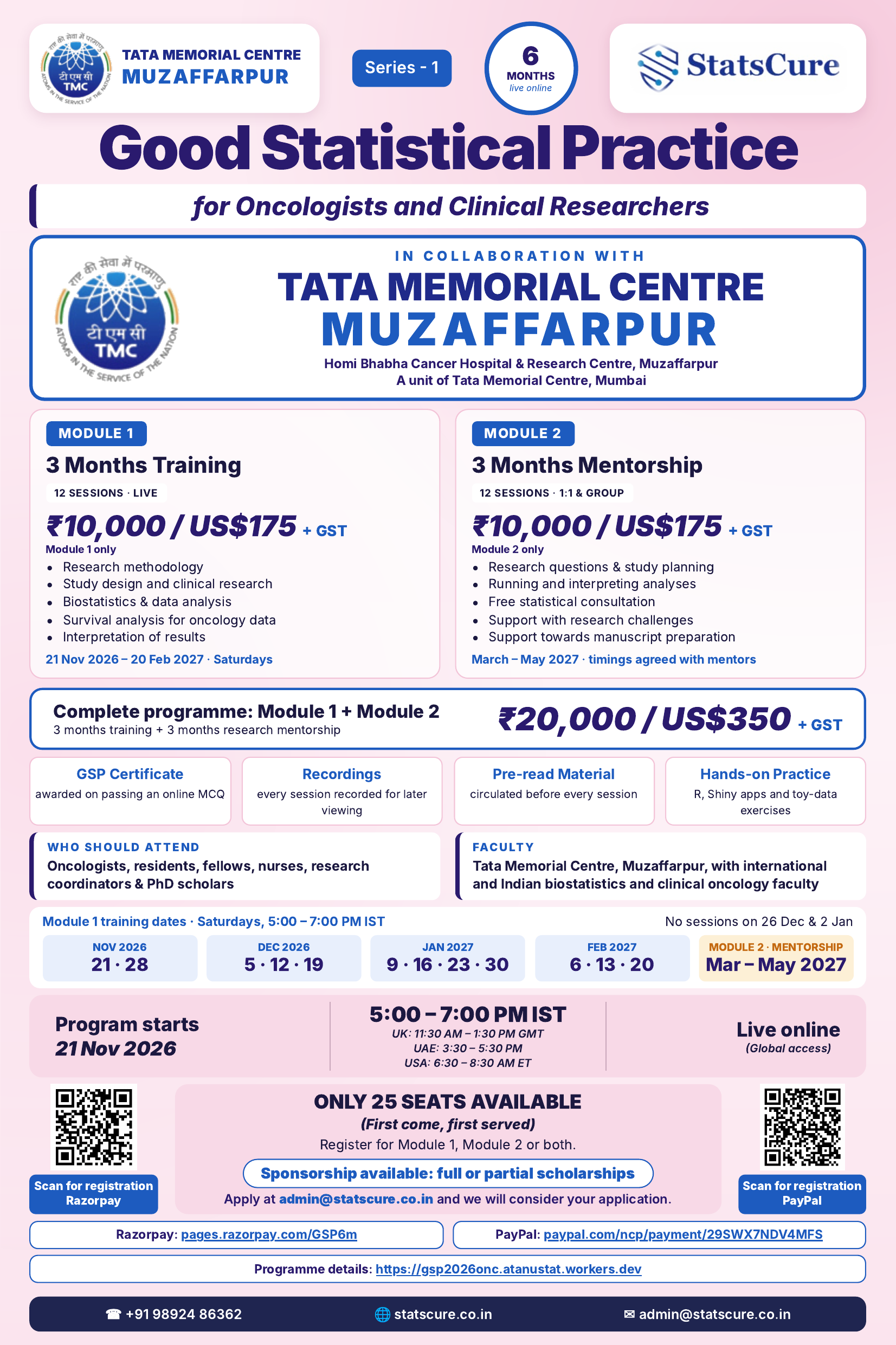
Good Statistical Practice
for Oncologists and Clinical Researchers

IN COLLABORATION WITH
TATA MEMORIAL CENTRE
MUZAFFARPUR
Homi Bhabha Cancer Hospital & Research Centre, Muzaffarpur
A unit of Tata Memorial Centre, Mumbai
A unit of Tata Memorial Centre, Mumbai
6 months · live online
Starts 21 Nov 2026
Saturdays 5:00 – 7:00 PM IST
Only 25 seats
Sponsorship available · full or partial scholarships · apply
Programme flyer
Programme structure
MODULE 1
3 Months Training
12 SESSIONS · LIVE₹10,000 / US$175 + GST
- Research methodology
- Study design and clinical research
- Biostatistics & data analysis
- Survival analysis for oncology data
- Interpretation of results
21 Nov 2026 – 20 Feb 2027 · Saturdays
MODULE 2
3 Months Mentorship
12 SESSIONS · 1:1 & GROUP₹10,000 / US$175 + GST
- Research questions & study planning
- Running and interpreting analyses
- Free statistical consultation
- Support with research challenges
- Support towards manuscript preparation
March – May 2027 · timings agreed with mentors
Complete programme: Module 1 + Module 2
3 months training + 3 months research mentorship
3 months training + 3 months research mentorship
₹20,000 / US$350 + GST
Mentorship timings will be decided mutually by participants and mentors.
GSP Certificateawarded on passing an online MCQ
Recordingsevery session recorded for later viewing
Pre-read Materialcirculated before every session
Hands-on PracticeR, Shiny apps and toy-data exercises
WHO SHOULD ATTEND
Oncologists, residents, fellows, nurses, research coordinators & PhD scholars
FACULTY
Tata Memorial Centre, Muzaffarpur, with international and Indian biostatistics and clinical oncology faculty
Dates
Module 1 training dates · Saturdays, 5:00 – 7:00 PM ISTNo sessions on 26 Dec & 2 Jan
| NOV 202621 · 28 | DEC 20265 · 12 · 19 | JAN 20279 · 16 · 23 · 30 | FEB 20276 · 13 · 20 | MODULE 2 · MENTORSHIPMar – May 2027 |
Program starts21 Nov 2026
5:00 – 7:00 PM ISTUK 11:30 AM – 1:30 PM GMT · UAE 3:30 – 5:30 PM · USA 6:30 – 8:30 AM ET
Live onlineGlobal access
Registration
Only 25 seats available (first come, first served)
Register for Module 1, Module 2 or both.
Sponsorship available: full or partial scholarships
Apply at admin@statscure.co.in and we will consider your application.
- For the full six-month programme (Module 1 training and Module 2 mentorship), use the full programme Razorpay link. For the 3-month training (Module 1) only, use the Module 1 Razorpay link. You can also register via PayPal.
- Complete your details and payment on the page.
- You will receive a confirmation and the joining details by email.
Series 1 programme
Module 1 · Training: 12 live sessions
Saturdays, 5:00 – 7:00 PM IST. Pre-read material is circulated before every session and every session is recorded.
| No. | Date | Session |
|---|---|---|
| 1 | 21 Nov 2026 | Biostatistics in oncology and study designs; cancer data and exploratory analysisEvidence hierarchy, observational and experimental designs, bias, confounding and immortal-time bias; data types, analysis-ready datasets and the baseline Table 1 |
| 2 | 28 Nov 2026 | Diagnostic and screening test evaluation; effect measures and confidence intervalsSensitivity, specificity, PPV/NPV, likelihood ratios and ROC curves for tumour markers; risk ratio, odds ratio, hazard ratio, number needed to treat and confidence intervals |
| 3 | 5 Dec 2026 | Hypothesis testing; comparing means and response rates; non-parametric methodsType I and II error and multiplicity; t-tests, ANOVA, chi-square and Fisher’s exact tests for response rates; Wilcoxon and Kruskal–Wallis tests, RECIST categories and waterfall plots |
| 4 | 12 Dec 2026 | Introduction to survival analysis; comparing survival curvesCensoring, OS, PFS and DFS, Kaplan–Meier estimation, median and landmark survival; log-rank and stratified log-rank tests, number-at-risk tables and crossing curves |
| 5 | 19 Dec 2026 | Cox proportional hazards model; beyond the hazard ratioHazard ratios, adjustment, stratification and the proportional-hazards check; time-varying covariates, non-proportional hazards under immunotherapy and restricted mean survival time |
| 6 | 9 Jan 2027 | Competing risks; multistate models and clinical pathwaysCause-specific and subdistribution hazards, cumulative incidence and the Fine–Gray model; illness-death and progression-to-death models |
| 7 | 16 Jan 2027 | Endpoints; phase I dose-finding designsOS, PFS, ORR and duration of response, surrogate endpoints and their validation; MTD, 3+3, CRM and BOIN designs, escalation and expansion cohorts |
| 8 | 23 Jan 2027 | Phase II designs; phase III randomised controlled trialsSimon’s two-stage design, single-arm and randomised phase II, go/no-go rules and futility; randomisation, stratification, blinding, ITT and per-protocol analyses, event-driven trials |
| 9 | 30 Jan 2027 | Sample size and power; adaptive, Bayesian and platform designsEvent-based sample size for survival endpoints, non-inferiority and equivalence; interim analyses and stopping boundaries, basket and umbrella trials, master protocols, Bayesian adaptive randomisation |
| 10 | 6 Feb 2027 | Biomarkers; regression for oncology outcomesPrognostic versus predictive biomarkers, subgroup pitfalls and interaction tests; logistic, Poisson and negative-binomial models; building and validating a prognostic model |
| 11 | 13 Feb 2027 | Meta-analysis of oncology trials; real-world evidence and external controlsPooling hazard ratios, fixed and random effects, forest and funnel plots, heterogeneity, network meta-analysis; registry and EHR data, propensity scores, external control arms, target-trial emulation |
| 12 | 20 Feb 2027 | Missing data and quality-of-life endpoints; critical appraisal and reportingInformative censoring, multiple imputation and sensitivity analyses; CONSORT and RECIST reporting and common statistical errors |
Module 2 · Mentorship: 12 one-to-one and group sessions
March to May 2027, with timings agreed mutually by participants and mentors. The sessions apply the training topics to each participant’s own research work.
March 2027
- Refine each participant’s research question
- Agree the study design and statistical analysis plan
April 2027
- Run the planned analyses on the participant’s own data
- Interpret the results and resolve analysis problems
May 2027
- Prepare tables, figures and the results section for a manuscript
- Present each project from design to interpretation